HKSTP Ideation Programme

Our City Health

The Operating System for Civic Intelligence.

"Turning the noise of the city into a precise, real-time credit score."

Section A

Key Summary

Our Mission

Every million-dollar decision deserves real-time civic intelligence.

We're building the first geo-centric social layer for capital allocation — where developers, retailers, and enterprises can quantify the invisible risks that delay projects, close stores, and waste millions.

Our City Health provides real-time civic intelligence for location-based decision-making — turning neighborhood sentiment into actionable risk metrics. Starting with Physical Asset Owners (Real Estate, Retail) and expanding to Scale Markets (Insurance, Government, Logistics, Corporate Security).

70%

of housing projects delayed by community opposition (NIMBYism)¹

15-25%

of project value lost annually to delays in major cities²

30-50%

of retail locations fail within 3 years globally³

Why This Matters

Billions of dollars flow into location-based decisions every year — property development, store openings, supply chain routes, insurance underwriting — all based on incomplete data. Organizations have perfected measuring the physical and financial — but they're flying blind on the social.

We believe location intelligence should be predictive, not reactive. It should tell you which neighborhood is ready to resist change 3 months in advance — not when it's already too late. That's the future we're building.

Developers and retailers have mastered the Financial Stack (Argus, Excel) and the Physical Stack (CoStar, Placer.ai). But the Social Stack remains unmeasured and unquantified.

Existing tools measure Activity (foot traffic) or Amenities (cafe count). But no digital tool reliably captures Adversarial Sentiment or Entitlement Risk.

This gap forces teams to rely on manual scouting of the district, like attending town hall meetings, and gut feelings to predict if a community will block their project—a "1990s workflow" for million-dollar decisions.

Great tools exist for brand monitoring (Brandwatch) and government policy (Zencity). But their architecture doesn't fit private sector location risk. Brandwatch is Entity-Centric — you search "Starbucks" and track brand mentions. Zencity is built for governments — not private developers. We are Geo-Centric: select a district or coordinates, and we capture all sentiment about that location — rent control protests, safety complaints, gentrification anger — regardless of what brands are mentioned.

Sources: McKinsey Global Infrastructure Initiative (15-25% annual project value loss in major cities); JLL Global Retail Report 2024 (30-50% failure rate in first 3 years); Global real estate research across major urban markets (London, Tokyo, Singapore, New York, Hong Kong).

Predictive

Detect opposition before you bid

Semantic

AI reads "I feel unsafe" not just "Crime"

Auditable

Click any score to see the source

Standardized

Compare any city instantly

Section B

Problem & Market Context

The Entitlement Cliff — A Multi-Million Dollar Blind Spot.

Developers and retailers spend millions on physical due diligence and financial modeling. Existing tools (CoStar, Placer.ai, Esri) provide demographics, traffic, and infrastructure data — but they don't measure community sentiment or opposition risk. Even tools like Brandwatch (entity-centric, tracks brand mentions) and Zencity (built for governments) don't address private sector location risk. Teams still rely on manual site walks and town hall meetings to assess whether a neighborhood will fight their project. This blind spot costs HK$6-8M per year of project delay.

The Entitlement Cliff

Community opposition is the #1 killer of real estate and retail projects

70%

of housing developments delayed by NIMBYism

41%

of retail locations fail within 5 years

15-25%

of project value lost annually to delays

A developer buys land in a major city. They plan to build apartments. The local community hates it. They protest. They sue. The project gets delayed 3 years. The developer loses 15-25% of the project value annually in carry costs. Yet their only tool for predicting this? Sending someone to a town hall meeting.

Sources: McKinsey Global Infrastructure Initiative (15-25% annual project value loss in major cities); JLL Global Retail Report 2024 (30-50% failure rate in first 3 years); Global real estate research across major urban markets (London, Tokyo, Singapore, New York, Hong Kong).

The "Ghost Mall" Problem

Placer.ai shows traffic is down 15%. But why? Is it safety? Parking? Gentrification anger? A boycott? GPS data can't tell you. We explain the "why."

The "Boiling Frog" Problem

Dataminr alerts you when the riot starts. But by then, the glass is already broken. Real estate is illiquid — you can't move your building. We detect the gas leak 6 months before the explosion.

The "Black Box" Problem

Competitors like Dataminr are famous for sending alerts with no source citations. An Investment Committee won't approve a multi-million dollar deal on faith. We let them click the link and read the Reddit thread.

The "Operational Blind Spot"

Supply chains and corporate travel teams rely on static risk reports. They miss the real-time sentiment shifts—like labor unrest or anti-foreign sentiment—that disrupt operations overnight. We detect "soft signals" before hard disruptions.

The Developer/Retailer Tech Stack — And What's Broken

Great civic intelligence tools exist — but their architecture doesn't fit private sector location risk. Brandwatch is Entity-Centric (tracks keywords, not locations). Zencity is built for governments (not private due diligence). We are Geo-Centric: monitor a district, capture all environmental sentiment.

Due Diligence Layer What They Measure Tools Used Status
Physical Layer Traffic, Buildings, Footfall, Zoning Placer.ai, CoStar, SafeGraph SOLVED
Financial Layer Rents, Yields, Cap Rates, Tax Argus, Excel, CoStar Comps SOLVED
Demographic Layer Income, Age, Education, Census Esri/ArcGIS, Census Data SOLVED
Social Layer Community Sentiment, Trust, Opposition, "Vibe" Site Walks, Town Halls, Brandwatch (limited), Zencity (limited) BROKEN

We don't replace these tools.
We are the "Social Layer" that completes their stack — digitizing the site walk and automating the town hall.

Section C

Proposed Solution

A Predictive Engine for Civic Intelligence.

We don't just show you what happened — we explain why it happened and predict what's coming next. Real-time scores + 5 years of historical data + AI-powered causal analysis.

The Architecture — Global Data Factory

Scalable infrastructure designed to ingest from 380,000+ sources across every major city

Ingestion Layer

380,000+ Sources

Global News (Reuters, AP, AFP, local papers)
Social Platforms (Reddit, X, Weibo, VK)
Regional Forums (HKGolden, PTT, 2ch)
Government Portals & Municipal Data
Review Sites (Google, Yelp, TripAdvisor)
Blogs, Newsletters, Telegram Channels
Expanding to thousands of hyper-local sources per city

Predictive Intelligence Engine

12-Dimension Scoring
Causal "Why" Analysis
Trend Prediction Models
5-Year Historical Archive

Output

API: Scores + Predictions
Dashboard: Why + What's Next
Reports: Deep Forecasts

The Semantic Edge

Legacy tools search for words. We search for meaning. This is why we catch risks that keyword filters miss.

Legacy Approach: Keywords

Traditional tools use Boolean keyword matching:

Search: "crime" OR "unsafe" OR "dangerous"

Problem: Misses posts like "I won't let my kids play outside anymore" or "The streetlights have been broken for months" — clear safety concerns without the keyword "crime."

Our Approach: Semantic AI

Our LLM understands context and intent:

Input: "I'm scared to walk home because the lights are out"
Output: Safety Score -2 | Dimension: Public Safety | Root Cause: Infrastructure

Advantage: Catches implicit sentiment, sarcasm, local slang, and complaints that don't use obvious keywords. Our geo-centric architecture captures all sentiment about a specific location — not just brand mentions — enabling true location-based risk assessment.

Universal Multi-Lingual NLP

Our semantic AI works across major global languages and regional dialects — including Cantonese, Mandarin, English, and many more. This isn't just translation; it's cultural context understanding.

Hong Kong Example

Detects HK slang and colloquial Cantonese that formal tools miss.

Global Reach

Simultaneously analyzes English Reddit, Mandarin Weibo, Cantonese LIHKG, Japanese 2ch, and local forums — no keyword translation needed.

Why It Matters

Real community sentiment lives in local languages. Legacy tools miss 80%+ of relevant data by only processing English.

Full Auditability — Not a Black Box

Competitors like Dataminr send alerts with no source citations — they protect their "IP." But an Investment Committee won't approve a multi-million dollar deal on faith.

Our Promise: Every score links back to the original source.

Example: "Safety Score dropped to 42 because of [15 Reddit threads about broken streetlights on 5th Ave]."
Your analyst can click the link and read the threads themselves.

Data Infrastructure: Scalable & Compliant

Our data acquisition strategy prioritizes legal, licensed sources that scale to hundreds of thousands of feeds while maintaining full compliance.

1

Tier 1: News Intelligence

Foundation Layer — Free to Low Cost

380,000+

sources

GDELT Project

300,000+ global news sources, 100+ languages

Free

NewsAPI

80,000+ sources with structured metadata

~HK$3,500/mo

Government Open Data

Municipal portals, World Bank, UN Data

Free

2

Tier 2: Social Intelligence

Licensed APIs — Moderate Cost

HK$7.8-39K/mo

estimated

Reddit Data API

Enterprise licensing for commercial use

~HK$1.87/1K calls

~HK$7,800/mo at scale

X/Twitter API

Basic to Pro tier access

HK$780-3,900/mo

3

Tier 3: Regional Expansion

Partnership Development — Phase 2

Partnerships

potentially

Regional forums (HKGolden, PTT, 2ch) and emerging market platforms require direct partnerships:

Weibo (China entity required) VK (Russia/CIS) Telegram Channels Regional Forums

Total infrastructure cost: HK$3,900-15,600/mo for 380,000+ legally licensed sources

The 12-Dimension Taxonomy

A comprehensive framework measuring the holistic health of any city down to the district level — not just crime stats or GDP

Each dimension is individually selectable for deep-dive analysis across any city and its districts in the database

Safety Housing Economy Governance Transport Environment Health Culture Education Tech Community Cost
Safety 80

Crime, public order, emergency response

Housing 40

Affordability, availability, quality

Economy 60

Jobs, wages, business climate

Governance 50

Policy trust, transparency, services

Transport 90

Infrastructure, accessibility, reliability

Environment 70

Air quality, green space, sustainability

Health 75

Healthcare access, public health

Culture 85

Arts, entertainment, diversity

Education 65

Schools, universities, opportunity

Tech 95

Innovation, connectivity, digital services

Community 55

Social cohesion, belonging, trust

Cost of Living 30

Affordability vs. income levels

Selectable

Click any dimension to drill down with extensive data, trends, and cited sources

Comparable

Compare any dimension across unlimited cities worldwide — Tokyo vs. London vs. São Paulo

Always Current

Continuous scraping solves the Latency Tax — real-time data, not 2-year-old snapshots

Primary Product

The Corporate Dashboard

Not just scores — explanations of why they changed and predictions of where they're heading. Historical context meets predictive intelligence.

The Mission: Predict, Don't React

Imagine opening a single interface and seeing not just the current health score of every city, but why it changed and where it's heading. Our AI doesn't just report "Safety dropped 8 points" — it explains: "Safety declined due to 340% increase in housing protest coverage, correlated with new rent control policy announced March 3rd."

With 5 years of historical data per city, you can see patterns that predict future shifts. Which cities recovered fastest after similar governance crises? What leading indicators preceded the last 3 economic sentiment drops in Singapore? The Corporate Dashboard transforms you from reactive decision-maker to predictive strategist.

Portfolio Management

Organize your cities and districts into logical groupings that mirror your business structure.

Create unlimited custom portfolios (e.g., "APAC Retail", "European Logistics", "GBA Manufacturing")
Drill down to district-level scores within each city for granular analysis
Aggregate scores across portfolios — see your regional risk at a glance
Share portfolios across team members with role-based permissions
Intelligent Watchlists & Alerts

Never miss a signal. Set custom thresholds at city or district level and get notified before problems escalate.

Threshold alerts: "Notify me if Safety in Lagos Central District drops below 60"
Velocity alerts: "Notify me if any dimension drops >10 points in 7 days"
Comparative alerts: "Notify me if Kowloon underperforms Central by >15 points"
Multi-channel delivery: Email, Slack, SMS, Webhook integrations
Predictive Analytics Engine

Go beyond the score. Understand WHY it changed and WHAT'S NEXT.

Causal Attribution: AI explains which events drove score changes
Trend Forecasting: 30/60/90-day projections based on historical patterns
Leading Indicators: Early warning signals before major shifts
Deep Dive: Request Custom Intelligence Reports for in-depth analysis (20+ pages)
Multi-Location Comparison

Make apples-to-apples comparisons across cities and districts worldwide.

Side-by-side radar charts: Compare city or district profiles visually
Ranking tables: Sort 1,000+ cities and their districts by any dimension
Scatter plots: Plot Housing vs. Safety to find optimal expansion targets
Exportable comparison reports for board presentations

Dashboard Outputs & Deliverables

PDF Reports

Audit-ready exports with full citations

CSV/Excel Export

Raw data for your own analysis

Interactive Charts

Embed live widgets in your tools

Scheduled Reports

Weekly/monthly automated briefings

Enterprise Product

Custom Intelligence Reports

Predictive intelligence on demand. Not just "what happened" — why it happened, what's coming, and what you should do about it.

The Mission: Forecast-First Intelligence

Custom Reports answer the questions reactive data can't: "If Housing sentiment continues this trajectory, when will it cross our risk threshold?" or "Based on historical patterns, what's the 6-month outlook for Governance Trust in Jakarta?"

Our AI synthesizes 5 years of historical patterns with real-time signals to generate forecasts with confidence intervals. Each report explains the causal chain — not just "sentiment dropped," but exactly which policy changes, news events, and social conversations drove the shift, and what similar patterns have led to historically.

Forward-Looking
Predictive Reports

Where is this city or district heading? When should we enter?

Market Entry Forecast: 12-month trajectory for any city or district with confidence intervals

Trajectory Benchmarking: Compare momentum across cities/districts — who's rising, who's falling?

Go/No-Go Recommendations: Optimal timing and entry strategy

Leading Indicators: Early warning signals to monitor post-entry

• District-level granularity for hyper-local market entry decisions

Delivery: 20-30 page report (5-7 day turnaround)

Backward-Looking
Analytical Reports

What happened, why did it happen, and what can we learn?

Event/Crisis Analysis: Exact causal chain that triggered the score change

Root Cause Breakdown: Which policies, events, or conversations drove the shift?

Historical Pattern Matching: How long did similar situations last elsewhere?

Recovery Timeline Estimate: Based on comparable case studies

• Full citation trail for audit compliance and board presentations

Delivery: 15-20 page report (48-72 hour turnaround)

Report Methodology

1

Scope Definition

Converse with AI Chatbot to clarify questions, success criteria & analysis scope

2

Data Extraction

Pull relevant signals from our database

3

Analysis

Human + AI synthesis of findings

4

Validation

Fact-check all claims with citations

5

Delivery

Report + presentation + Q&A session

Every report includes full source citations, methodology documentation, and executive summary for audit compliance.

Current Progress

Working prototype demonstrating proof-of-concept for key pipeline elements. Incomplete but functional.

City Coverage

100 cities operational — scalable to 1,000+

News Sources

Hundreds of outlets including wire services

Social Platforms

Reddit only — X, Weibo in Q1

Interface

3D globe + dashboard built

1

Universal Scraping Engine

Backend data pipeline in action
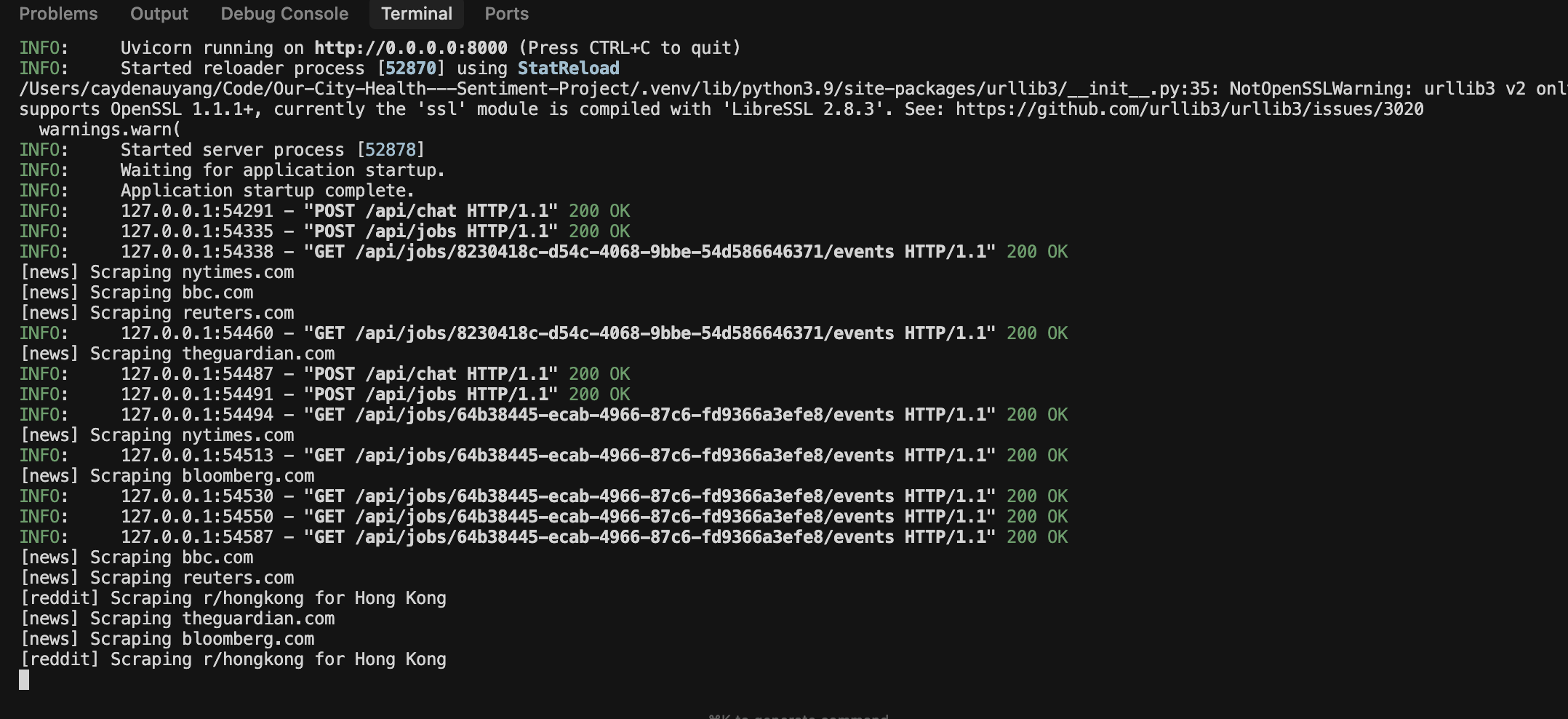
Terminal Backend

What you're seeing: The FastAPI backend running live scraping jobs. The engine ingests from multiple news sources (NYTimes, BBC, Reuters, The Guardian, Bloomberg) and Reddit communities simultaneously, processing data for the selected city (Hong Kong). This pipeline also handles AI-based scoring for each dimension through the proprietary scoring engine, which is currently under active development. Goal: Scale to 380,000+ sources via licensed APIs and data partnerships.

FastAPI + Uvicorn Multi-source ingestion Real-time job tracking Reddit API integration
2

Interactive 3D Globe Interface

Public-facing visualization layer
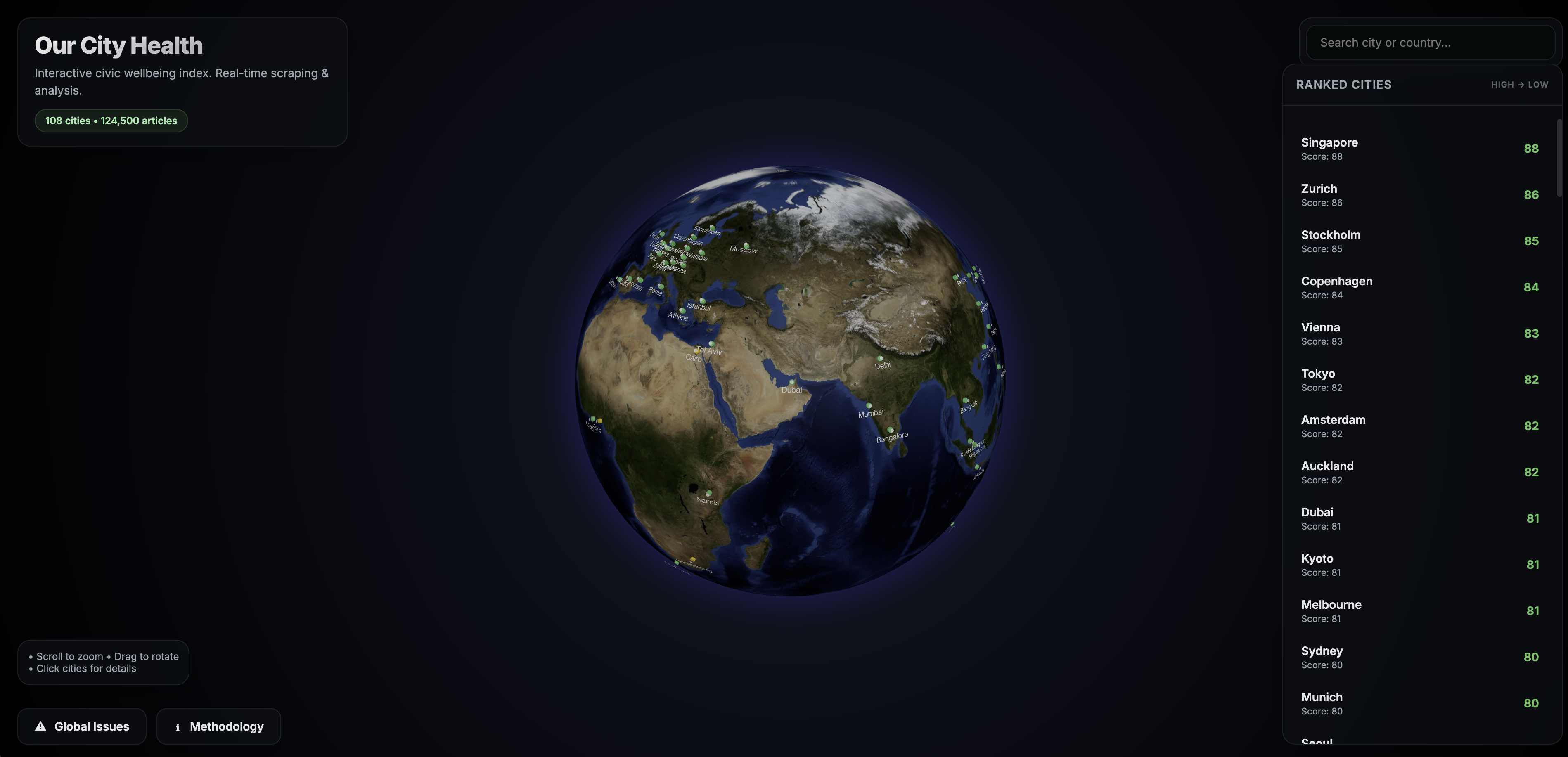
3D Globe Interface

What you're seeing: A WebGL-powered 3D globe displaying real-time Civic Health Index scores for 108 cities. Users can rotate, zoom, and click on any city to see detailed scores across all 12 dimensions. Goal: Enable zooming to district-level with 12-dimension scores at district granularity.

Three.js rendering Real-time scores Ranked city leaderboard Search & filter
3

Corporate Intelligence Dashboard

Enterprise B2B interface (early prototype)
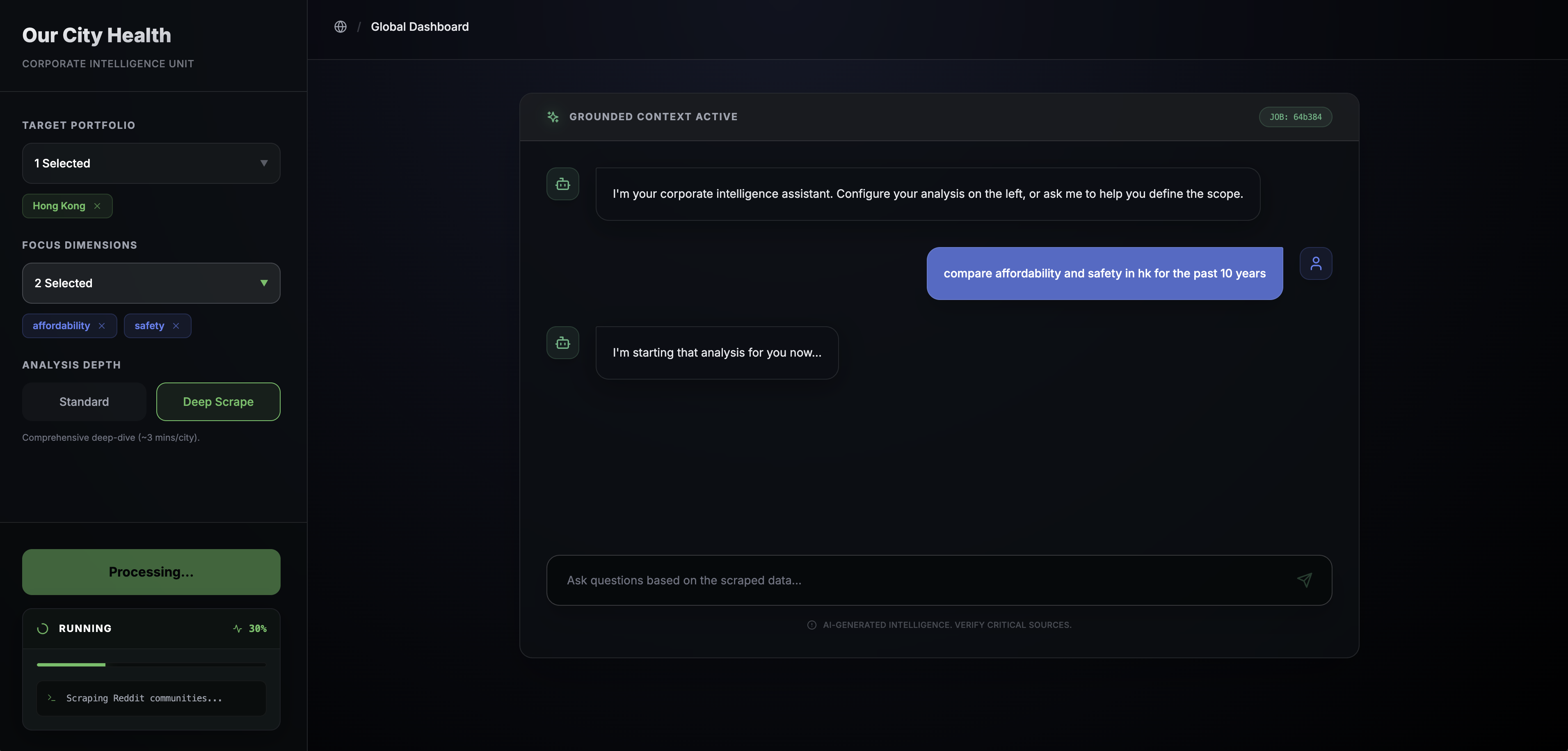
Corporate Dashboard 12-Dimension Scoring Demo

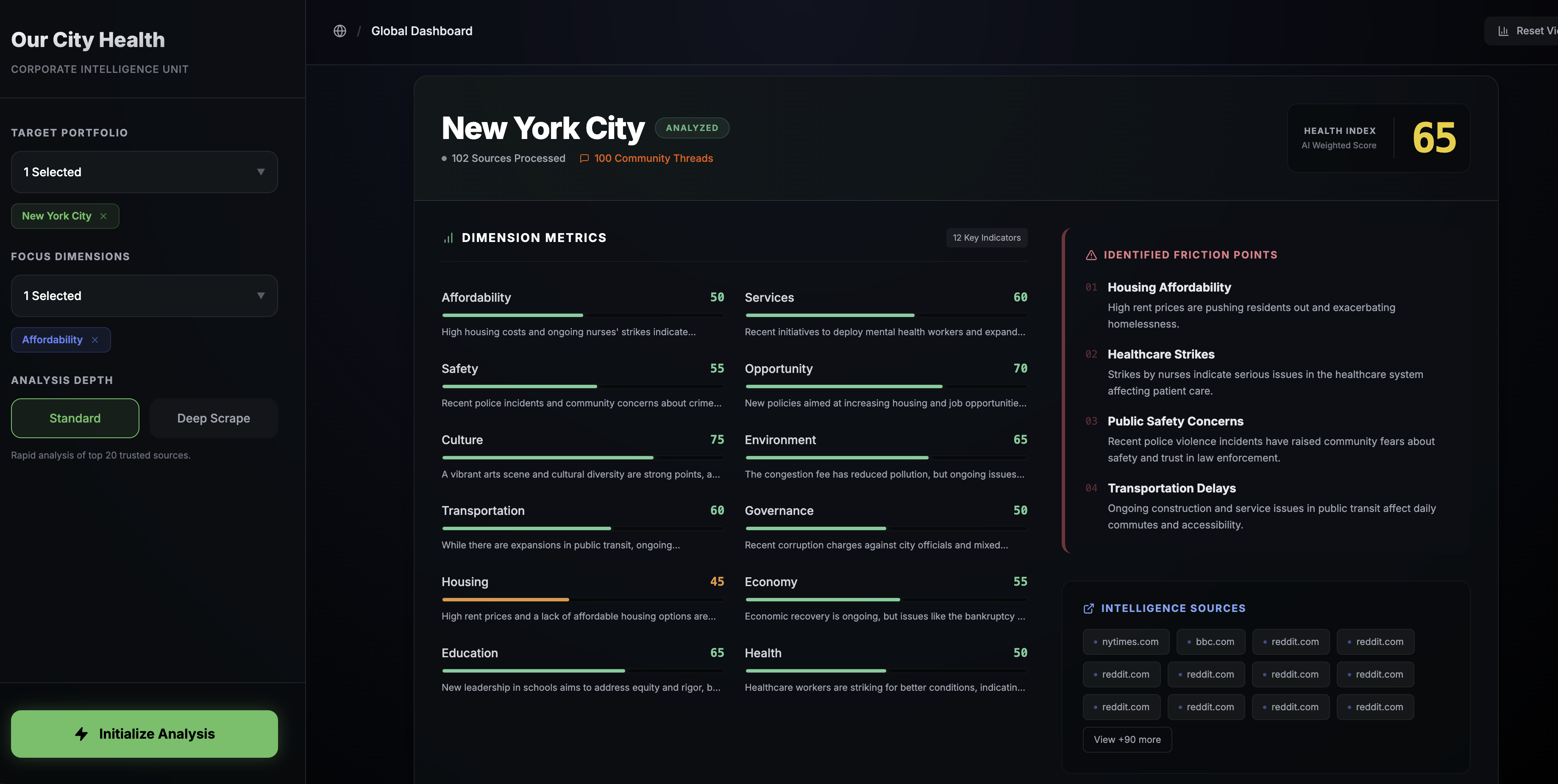
What you're seeing: Early prototype of the Corporate Intelligence Unit. Portfolio selection (Hong Kong), dimension filtering (affordability + safety), and a "Grounded Context" AI chat that answers questions using only scraped data — no hallucinations. The second image showcases an initial basic sample demonstration of city-level analysis across the 12 dimensions, powered by the foundational scoring engine currently in development. Goal: Custom portfolios, intelligent alerts, multi-location comparison, predictive analytics, full Custom Intelligence Report integration, and refinement of the 12-dimension proprietary scoring methodology (ongoing research into weighting algorithms and dimension interdependencies).

Portfolio management Dimension filtering Grounded AI chat Deep scrape on demand

Status: Core infrastructure validated. These POC elements demonstrate the technical feasibility. Ready for Q1 scaling push.


Section D

Market Opportunity

The "Social License" Gap — A Blue Ocean in Site Intelligence.

Why This Specific Market?

The "Security" market is saturated (Dataminr). The "Traffic" market is dominated (Placer.ai). But there is no dominant player providing Qualitative Civic Health Trends to the private sector. We bring standardized civic health metrics to commercial strategy teams — measuring neighborhood sentiment, community cohesion, and social stability that existing tools miss.

Security Market

Dataminr, Control Risks

Saturated

Traffic Market

Placer.ai, SafeGraph

Dominated

Social License Market

Civic health tools (gov/public sector only)

Open for Private Sector

Market Sizing: Commercial Risk Intelligence

Focused on the "Social Layer" gap in site selection, operational monitoring, and community risk assessment — a subset of the broader commercial intelligence market.

HK$265B (USD $34B)

TAM

Total Addressable Market

Global Real Estate & Retail Analytics Market — includes all data/analytics tools used for site selection, risk assessment, and market intelligence (Placer.ai, CoStar, Local Logic, Esri, consultancies).

HK$32.8B (USD $4.2B)

SAM

Serviceable Addressable Market

Alternative Data & Sentiment Analytics — subset of companies actively seeking qualitative insights (social sentiment, community data) beyond traditional demographic/financial data.

HK$663M (USD $85M)

SOM

Serviceable Obtainable Market

Year 3 Revenue Target — mid-size developers and retailers expanding internationally (APAC, Europe, North America) who lack reliable civic intelligence on unfamiliar markets.

Sources: Grand View Research "Real Estate Analytics Market Report 2024" (USD $34B TAM); MarketsandMarkets "Alternative Data Market 2024" (12.4% CAGR); Internal market analysis for focused SOM estimate.

Our Target Customers — Prioritized

We are launching with industries where "Community Sentiment" is a multi-million dollar blind spot and existing tools have clear gaps. This focused go-to-market strategy allows us to prove product-market fit before expanding to additional verticals.

PRIMARY ANCHOR

Commercial Real Estate — Land Acquisition Teams

Pre-Bid Community Screening

The User

VP of Development, Land Acquisition Manager

The Pain

Buy land in major city → community hates it → protests → lawsuits → 3-year delay → lose 15-25% of project value annually in carry costs

Current Solution

Existing tools (CoStar, Esri) provide demographics and physical infrastructure but miss community sentiment. Tools like Brandwatch track brand mentions (entity-centric) but not location-based sentiment — they can't tell you if a neighborhood opposes development. Developers still rely on manual site walks and town hall meetings to assess social opposition risk.

Our Value Proposition

Before bidding on land, run a "Civic Health Check" across the 12 dimensions for the specific city or district to quantify Entitlement Risk using real-time sentiment data. Set intelligent alerts to monitor sentiment shifts, conduct daily progress tracking during due diligence, run multi-region comparisons to identify lower-risk opportunities, and request Custom Intelligence Reports (20+ pages) analyzing historical resistance patterns, predictive timelines, and peer city benchmarks. Identify if the neighborhood has:

Low Community Cohesion

Fragmented — protests likely

Low Governance Trust

Anti-development sentiment

High Housing Stress

Gentrification anger brewing

"Anti-Delay Insurance" — know if a community will fight your project before you buy the land.

Target Companies:

Mid-size developers expanding internationally, regional developers entering unfamiliar markets, overseas land acquisition teams

Retail & QSR Site Selection

The "Vibe Check" for Expansion

The User

Head of Real Estate, Site Selection Committee

The Pain

Open store in trending-down neighborhood → significant lost sales and operating losses → joins 30-50% that fail within 3 years

Current Solution

Placer.ai shows foot traffic numbers but not "why" traffic is trending. Tools like Brandwatch track brand mentions (entity-centric) but not location-based sentiment for specific districts. Site selection teams still rely on manual site walks and anecdotal local interviews to assess neighborhood sentiment.

Our Value Proposition

Run a "Civic Health Check" across the 12 dimensions for the specific city or district. Overlay our "Safety Sentiment & Cultural Vibrancy" scores on top of Placer.ai traffic data to explain trends and predict future performance. Compare multiple locations side-by-side across all dimensions, set alerts for sentiment threshold breaches, track daily score changes for shortlisted sites, and order Custom Intelligence Reports with market entry forecasts, trajectory benchmarking against peer locations, and 30/60/90-day sentiment projections:

Placer.ai says: "Traffic is high at this corner."

We add: "But 'Safety Sentiment' has dropped 15% in 6 months due to loitering complaints. Consider the mall 2 miles north instead."

Target Companies:

Regional QSR franchises expanding overseas, mid-size F&B chains entering new markets, CPG companies expanding international distribution

TIER 2 — SCALE MARKETS

P&C Insurance

Parametric Risk Modeling

Use Case: If "Governance Trust" collapses in a region, riot risk goes up. Mid-sized domestic insurers need predictive civic signals but can't afford to build proprietary platforms.

Value: Parametric triggers based on real-time sentiment scores to adjust reserves and pricing.

Longer sales cycle, but validates deep tech credibility.

Government & Smart City

Policy Impact Measurement

Use Case: Real-time civic sentiment to understand policy effectiveness, identify emerging issues before escalation, and benchmark against peer cities or districts.

Value: Track trust and satisfaction scores across many dimensions in real-time. Continuous pulse checks vs. expensive annual surveys.

Validates product legitimacy and creates public case studies.

Logistics & Corporate Security

Supply Chain & Duty of Care

Use Case: Static risk reports miss real-time labor unrest or anti-foreign sentiment that disrupt port operations and executive travel overnight. Existing government-backed tools only send emergency high-risk alerts, not the soft signals that predict escalation.

Value: Live alerts for shipping hubs and travel destinations. Detect "soft signals" before hard disruptions.

Operations teams need daily intelligence, not quarterly reports.

FUTURE HORIZON

Once core platform is validated with Physical Asset Owners and Operational Risk Teams, we will expand to: Quantitative trading firms (mid-size macro funds, municipal bond specialists). This is a crowded but addressable market once we have proven case studies and audit-ready data.

🇭🇰

Hong Kong & GBA as Launch Market

Local SMEs expanding overseas — we provide intelligence on unfamiliar markets

HK and GBA companies face massive information asymmetry when expanding internationally. While they know their home market intimately, they lack reliable civic intelligence on overseas destinations — especially in emerging markets and niche cities where data is scarce.

We fill that gap by providing standardized, real-time civic health data on smaller markets, second-tier cities, and regions that mainstream data providers don't cover well.

Our Value to HK/GBA Companies:

"You know Hong Kong. We tell you about everywhere else — especially the places where good data doesn't exist yet."

Built for Hong Kong & GBA's Multi-Lingual Reality

Our AI natively processes Cantonese, Mandarin, and English — including HK slang, colloquial Cantonese (粵語), and regional dialects. This isn't just translation; we understand cultural nuance and local context that generic tools miss.

Why it matters: When your HK-based F&B chain expands to Southeast Asia, we analyze sentiment in local languages (Thai, Bahasa, Vietnamese) — not just English summaries that miss 80% of real community conversations.

HK/GBA SMEs expanding globally are already in HKSTP's ecosystem — providing immediate, warm access to first customers.

Section E

Competitive Analysis

We Don't Replace — We Complete.

Your customers already invest millions in specialized tools — from alert platforms (Dataminr, Placer.ai) to civic/marketing intelligence (Brandwatch, Zencity, Meltwater) to consultancies (McKinsey, Deloitte). We're not replacing these. We fill the geo-centric, location-based risk intelligence gap that none of them cover.

Feature Our City Health Alert Platforms
(Dataminr, Placer.ai)
Civic/Marketing Platforms
(Zencity, Brandwatch, Meltwater)
GenAI Wrappers
(Custom GPTs, Claude Projects)
Consultancies
(McKinsey, Deloitte)
Output Type Structured Database + Alerts + Custom PDF Reports Real-time alerts & traffic analytics Sentiment dashboards & reports Conversational text summaries One-time strategic PDF reports
Time Horizon Real-time + 5-year historical archive Real-time only, limited history Real-time with some historical No memory between sessions Point-in-time (6-12 mo lag)
Granularity City + District level Incident/Store level City/Topic level (entity-centric) Variable, depends on prompt City/Country level
Audit Ready Full source citations Some only Yes Hallucinates facts Yes
Insight Level "Why" (causal context & predictions) "What/Where" (events & movement) "What" (brand/policy sentiment) "What" (creative synthesis) "Why" (deep but lagging)

What Each Tool Can Answer

Different tools answer different questions. Only one answers all five.

Question for the Developer Placer.ai Dataminr Brandwatch Zencity ChatGPT/Claude McKinsey Our City Health
"How many people are here?"
"Did a disaster just happen?"
"Is this neighborhood getting better or worse?"
"Why are tenants/customers leaving?"
"Will the community oppose our project?"
= Yes  |  = Partial (requires setup or has limitations)  |  = No

Key Insight: Each tool excels at its niche, but none combines geo-centric location intelligence, real-time + historical data, and predictive entitlement risk in one pre-built package. That's our gap.

Why Their Architecture Doesn't Fit Private Sector Location Risk

Brandwatch is Entity-Centric (tracks keywords). Zencity is built for governments. Neither architecture fits private sector location-based due diligence.

🎯

Entity-Centric vs. Geo-Centric

Brandwatch is Entity-Centric: You search "Starbucks" → it finds all mentions of "Starbucks" across the internet.

The Architectural Limitation:

Anti-gentrification protest outside Starbucks. Chants about "Rent Control" and "Capitalism." Nobody mentions "Starbucks."

Brandwatch sees: Nothing. The keyword wasn't used.

We are Geo-Centric:

Select a district or coordinates → we capture all sentiment about that location: rent protests, safety complaints, gentrification anger — regardless of what entities are mentioned.

"Brandwatch tracks the Brand. We track the Battlefield."

💰

The Setup Tax

Brandwatch is an "Empty Box." Powerful, but requires custom setup per city.

The Hidden Cost:

Track "Civic Stability" across 50 global assets? You need complex boolean queries per city, per language. That's an ~HK$620K/year analyst just to maintain queries.

Our 12-Dimension Taxonomy:

Pre-built. Pre-translated. Works out of the box for 1,000+ cities. No query engineers required.

"Brandwatch is a DIY kit. We are the finished product."

🏛️

Government Tool ≠ Developer Tool

Zencity is built for governments. Its product is designed for public sector policy feedback, not private sector due diligence.

Different Use Cases:

Governments need to understand citizen satisfaction and policy sentiment. Developers need to predict if a community will block their project.

A tool built for governments isn't designed for private developer risk assessment.

We are built for private sector location risk:

Is the neighborhood hostile to development? Will residents fight my project? Quantify the "Entitlement Risk" before you bid.

"Zencity serves governments. We serve developers and operators."

Regulatory Barriers to Entry

Unlike consumer data plays, civic intelligence requires navigating complex cross-border compliance — creating significant moats for early entrants.

🇪🇺

GDPR (Europe)

Strict consent and data processing rules. Our aggregation-only model (no PII collection) ensures compliance while competitors struggle with individual-level tracking.

🇨🇳

PIPL (China) & DSL

Cross-border data transfer restrictions. Our HK-based infrastructure enables GBA analysis while respecting mainland data sovereignty requirements.

🌏

Regional Variations

PDPA (Singapore), APPI (Japan), LGPD (Brazil) — each market has unique rules. Early compliance investment creates 12-18 month head-start vs. new entrants.

Compliance complexity = competitive moat. We're building this foundation from Day 1.

Section F

Business Model & Milestones

A Scalable DaaS (Data-as-a-Service) Engine.

All prices in Hong Kong Dollars (HKD)

Free

Explorer

Try the platform

  • 100 cities maximum
  • City-level scores only (no district)
  • • Basic portfolio management
  • • Basic multi-city comparison
  • • No custom intelligence reports
  • • No alerts
  • • Community support

Lead generation & market validation

STARTER
HK$1,500/mo

Professional

For growing teams

  • Unlimited cities
  • District-level scores for 5 cities
  • • Full portfolio management
  • Email alerts for selected cities/districts
  • • Basic multi-city comparison
  • • Basic predictive analytics (dashboard)
  • • No custom intelligence reports (PDF)
  • • Priority support

HK$18,000/yr billed annually

POPULAR
HK$50,000/yr

Enterprise

Full-featured intelligence

  • Unlimited cities
  • Unlimited district-level scores
  • • Full portfolio, alerts, comparison
  • Custom Intelligence Reports (20+ pages)
  • • Predictive & Analytical reports
  • • Email + dashboard alerts
  • Limited API access (usage cap)
  • • Dedicated CSM

~HK$4,200/mo — most popular choice

HK$100,000/yr

Data License

Full API + integrations

  • Everything in Enterprise
  • Full API firehose
  • • Unlimited API calls
  • • All 1,000+ cities + districts
  • • Real-time JSON feed
  • • SLA guarantees
  • • White-label option
  • • Dedicated CSM

Quant teams, data integrations, resellers

Unit Economics: Why These Margins Work

Data Infrastructure

HK$3,900-15,600/mo

GDELT (free) + NewsAPI (~HK$3,500) + Reddit API (~HK$7,800)

Compute / LLM Costs

Variable

Scales with usage; HKSTP compute support critical

Gross Margin Target

70-80%

Typical for SaaS data products at scale

12-Month Execution Roadmap

From prototype to global platform

Q1
Q2
Q3
Q4

Scale & Team

  • Expand to 1,000+ cities
  • Scale to 380,000+ sources
  • Develop Predictive Engine v1, solidify 12-dimensional proprietary scoring engine
  • Hire BD Lead + Data Engineer
  • Interviews for quantified insights
Initial testing of predictive risk models

Product Development

  • Backtesting Validation (5-year historical)
  • Corporate Dashboard v1.0
  • Custom Report generation testing
  • Solidify predictive analytics capabilities
  • Basic pilot testing (2-3 regions and city cluster) and testing pilot success criteria
Full watchlist, alerts, and comparison features

Beta Launch

  • Launch API + Dashboard Beta
  • Outreach to small organizations
  • Early adopter feedback loop
  • Pricing validation & iteration
  • Pilot testing for 10 beta users
Target: 10 beta users (startups, SMEs, NGOs)

Commercial Launch

  • Full commercial availability
  • Enterprise sales outreach
  • First paid contracts signed
Target: 10+ enterprise customers, 15+ case studies

Section G

Core Team

An AI-Native Founder with High Technical Velocity.

Cayden Auyang

Cayden Auyang

Architect & Founder

Based: Hong Kong / Connecticut, USA

Education: Pomfret School

Head of School Scholar

caydenauyang@gmail.com

+1 (646) 889-4501

+852 9260 9370

github.com/CaydenAuyang

Languages:

English (Native) Cantonese (Native) Mandarin (Fluent) Spanish (Conversational)

The "Super-Dev" Advantage

Expert in Agentic AI Workflows (Cursor + Google Antigravity). Capable of executing engineering tasks at 5x the speed of a traditional developer, keeping burn rate near zero. Founded a productivity consulting business and automation group, self-developed AI + automation projects like a macOS GUI agent and browser-based games ranging from FPS to educational games.

Civic AI Group — Founder & President

Founded a school-wide group with 20+ students and advisors dedicated to leveraging AI to automate workflows for school faculty and nearby communities. Serving 4 diverse departments with 10+ cases.

AI Simply — Founder

Founded productivity consulting business that weaves best-in-class AI tools with custom code pipelines to automate and streamline workflows of SMEs and nonprofits, cutting their tedious tasks and allowing for the reclaiming of hundreds of hours. Working with clients from 7 different industries.

Wisers Information Limited — AI Engineering Intern

Self-developed a multi-step program that scrapes for thousands of posts on RedNote and provides an in-depth analysis of the latest fashion trends and market strategies of four major sportswear brands through LLM analysis and API bridging. The analysis is granular, covering aesthetic choices, industry background, financial performance, customer sentiment, and future recommendations.

Self-developed a macOS-based, window-targeted GUI automation agent that combines computer vision (YOLO + OCR) with LLM reasoning to perform autonomous, goal-driven interactions across arbitrary apps and websites on a UI.

The Commitment

Dedicated Gap Year (2027). Will focus 100% full-time on scaling the venture post-graduation, with commitment to achieving product-market fit and first revenue.

Additional Leadership & Accomplishments

Academic

  • • Head of School Scholar (Highest Academic Award)
  • • SAILING Leader (Student AI Literacy Group)
  • • Board Member, Advancement Student Board

Athletics & Arts

  • • Captain of Varsity Squash Team
  • • Tri-Varsity Athlete (Cross Country, Squash, Track)
  • • Drummer & Percussionist, Hon Contemporary Music Band

Key Advisor

Alvin Mok

Alvin Mok

Key Advisor

Chief Information and Data Officer

Select Equity Group, L.P. (New York)

Former Roles:

  • • Head of Global Platform & Insights, Orbis Investments (USD $25B+ AUM)
  • • Engagement Manager, McKinsey & Company (Asia/China focus)
  • • Program Manager, Microsoft

Education:

  • Harvard Business School — MBA, Baker Scholar (Top 5%)
  • • University of Toronto — BASc Computer Engineering (Highest Cumulative Average, 2003)

17+ years leading data, analytics, AI, and technology teams at top-tier hedge funds and consultancies. Brings world-class expertise in alternative data strategy and enterprise-scale product development.

Section H

Why HKSTP

Strategic Alignment.

The "Ask" — Why We Need You

Compute Infrastructure

Scoring 1,000+ cities daily requires GPU inference at scale. HKSTP's supercomputing support is critical.

Ecosystem Access

HKSTP's network of HK & GBA companies expanding globally provides immediate warm introductions to first customers.

Compliance Guidance

Navigating PIPL, GDPR, and 50+ jurisdictions requires HKSTP's legal expertise.

Data Partnerships

Access to HKSTP's enterprise data partnerships for licensed API access (Reddit, regional sources, government feeds).

Ready to Build the Global Standard.

Geo-centric location intelligence for capital allocation decisions.

1,000+ cities. 380,000+ sources. 12 dimensions. One platform.

Contact: caydenauyang@gmail.com